
CNC gasket cutting · die-less production
CNC Gasket Cutting Machines for Rubber, PTFE and Fibre Sheet
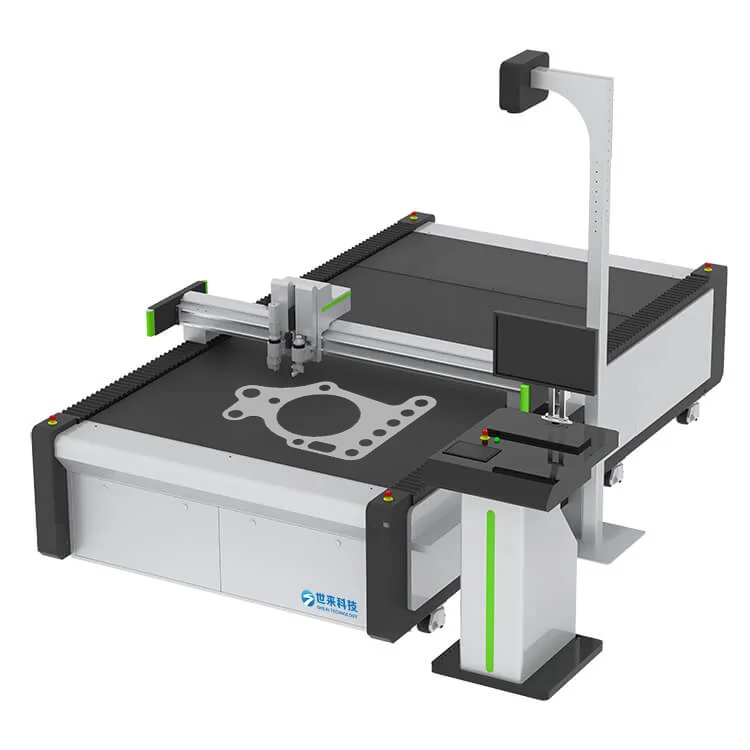
A CNC gasket cutting machine uses an oscillating knife to cut non-metallic sealing sheet directly from a DXF or CAD file. It removes die cost and lead time for samples, replacement parts and short runs, while holding thin compressible sheet flat with zoned vacuum and producing clean bolt holes and flange profiles.
- ±0.1 mm on thin gasket sheet
- 40 mm standard cutting depth
- No steel die or minimum order
The production problem
The die is not the only cost. Waiting for it is.
A maintenance team pulls a flange gasket from a heat exchanger at 4 pm. The die shop quotes five working days plus a die charge for one size. Hand cutting gets the plant running, but oval bolt holes and a wavy profile can leak under torque.
Gasket manufacturers face the same issue at the front of the order cycle: every flange size, material grade and design revision can create another die, another rack slot and another delay. The production press is efficient only after that tooling exists.
A knife table separates the shape from the tool. The drawing is the tool. Change a bolt circle, add a tab or switch from compressed fibre to PTFE and cut the next part from the revised file.
How the machine solves it
From drawing to finished part, without a die
Three decisions determine whether the process is reliable: tooling, hold-down and the workflow around the table.
CAD to part in one shift
Import DXF, AI or PDF geometry, nest the parts and cut. There is no die drawing, die machining or trial press stage for a one-off gasket.
Zoned vacuum holds thin sheet
Independent vacuum zones keep a small A4 blank as stable as a full 1.5 × 2 m sheet. That stability is what protects bolt-hole pitch and the outside profile.
A cold cut, not a burned edge
The blade severs the fibre instead of melting it. PTFE, rubber, graphite laminate and non-asbestos sheet leave the table without char, smoke or a hardened edge.
Material fit
Materials and tooling
Tell us the exact grade, thickness and sheet or roll size. The same material name can behave differently across suppliers.
| Material | Typical parts | Recommended tooling |
|---|---|---|
| Non-asbestos fibre sheet | Common flange gasket | Oscillating knife |
| Compressed fibre and gasket paper | Thin sheet, high volume | Oscillating or drag knife |
| Graphite laminate | Soft, abrasive sheet | Oscillating knife; edge support |
| PTFE | Chemically resistant gasket | Cold oscillating knife |
| Rubber and silicone | Sheet or roll | Oscillating or pneumatic knife |
Typical guidance only. A sample cut is required to confirm edge quality, hold-down and the practical tolerance for your material.
Platforms and models
Choose the working area around the part, not the catalogue
Table size, feeding method and tool count matter more than a model number. We can customize the working area around your sheet or roll.
SL6090FG
- Working area
- 600 × 900 mm
- Best fit
- Samples, small graphite and PTFE parts, MRO
SL1625FG
- Working area
- 1600 × 2500 mm
- Best fit
- Full sheet, replacement gaskets and short runs
SL1610CG
- Working area
- 1600 × 1000 mm + conveyor
- Best fit
- Rubber and silicone roll stock
SL1625FGD
- Working area
- 1600 × 2500 mm, dual head
- Best fit
- Higher-volume gasket production
Factory
Yucheng, Shandong
Assembly, testing and packing under one roof.
Quality system
ISO 9001:2015
Certificate 33926Q00457R053, valid to 30 June 2029.
Europe
ECM document review
0P260623.JSTTT50 reviews submitted documents only; it is not product verification or an EC Declaration of Conformity.
Commercial risk
Test before deposit
Send material; receive cut parts, parameters and a priced configuration.
What the test includes
Send three pieces. Get the cut on video.
Send three A4-sized pieces of the actual material and one drawing in DXF, AI or PDF. We cut at production speed and record the tool, frequency, feed, vacuum zoning and number of passes.
You receive the cut parts by courier, a parameter sheet, a tool recommendation and one priced configuration. No deposit is required to see the test.
Decision support
Questions buyers ask
Direct answers to the questions that usually arrive before a machine specification is approved.
How much does a CNC gasket cutting machine cost?
The final price depends on table size, knife configuration, conveyor or dual-head options, vision and destination. We quote a complete configuration after seeing the material, sheet size and daily output rather than publishing one misleading starting price.
Can it cut a one-piece gasket without a die?
Yes. A one-piece order is the clearest case for digital cutting: load the drawing, nest the part and cut without creating a steel die.
What tolerance should I expect?
Shilai publishes ±0.1 mm for suitable thin gasket materials. Thick, soft or highly compressible sheet can move under the blade, so the practical tolerance depends on material, thickness, hold-down and cutting parameters. The test cut should confirm the result on your sheet.
Is a laser better for PTFE or rubber?
Usually not. A laser can melt or char heat-sensitive sealing materials and create fumes. An oscillating knife is a cold process and typically produces the cleaner sealing edge.
Next step
Send a gasket sample. Get the cut, the parameters and a priced configuration.
Include the material, thickness, drawing and output. An engineer will reply within 48 hours, Monday to Saturday, GMT+8.