
CNC leather cutting · hide nesting
CNC Leather Cutting Machines for Automotive and Furniture
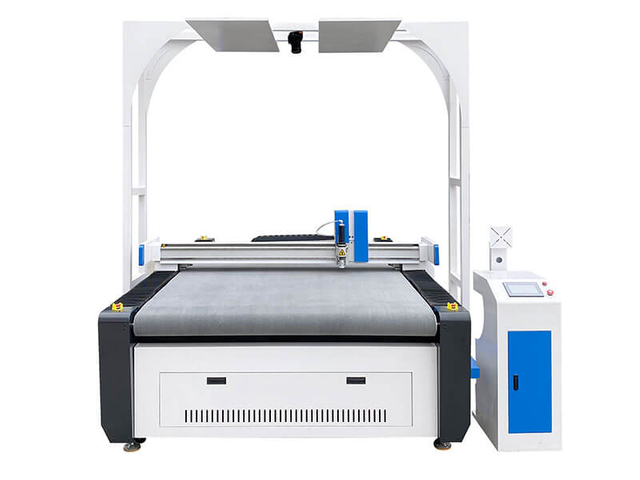
A CNC leather cutting machine combines a cold oscillating knife with hide recognition and nesting software. It finds the usable outline, avoids defects and packs pattern pieces into the available area, so manufacturers cut genuine and synthetic leather without steel dies and recover more usable material from every hide.
- Vision hide recognition
- Automatic defect avoidance
- Conveyor option for roll goods
The production problem
The cheapest hide is the one you use more completely.
Natural hide is irregular, variable and expensive. A manual cutter can follow a pattern, but cannot consistently remember where the scars, holes and soft spots were across a full lay. The result is avoidable scrap and pattern pieces that are cut twice or rejected later.
In automotive, furniture, footwear and bag production, small changes in yield matter more than a small difference in machine speed. Defect avoidance and nesting change the material cost on every hide.
A digital leather cutter turns the hide into a measured production surface. The camera captures the outline and defects, the software nests the pattern, and the knife cuts the selected pieces in one workflow.
How the machine solves it
From drawing to finished part, without a die
Three decisions determine whether the process is reliable: tooling, hold-down and the workflow around the table.
Hide recognition and defect mapping
The vision system identifies the usable hide boundary and marked defect areas before nesting. Patterns are placed inside the usable region rather than over damage.
Nesting that changes material yield
Intelligent nesting fits small pieces into offcuts around larger panels. The gain appears in every hide and is especially important for high-value leather.
Cold knife edge, no scorching
Oscillating and rotary knife tools cut leather, PU, PVC and microfiber without the hardened, discoloured edge associated with heat cutting.
Material fit
Materials and tooling
Tell us the exact grade, thickness and sheet or roll size. The same material name can behave differently across suppliers.
| Material | Typical parts | Recommended tooling |
|---|---|---|
| Cowhide and sheepskin | Genuine leather goods | Oscillating knife + vision |
| PU and PVC leather | Furniture and automotive | Oscillating knife |
| Microfiber leather | Seats, bags and trim | Oscillating or rotary knife |
| Suede and split leather | Footwear and upholstery | Rotary or oscillating knife |
Typical guidance only. A sample cut is required to confirm edge quality, hold-down and the practical tolerance for your material.
Platforms and models
Choose the working area around the part, not the catalogue
Table size, feeding method and tool count matter more than a model number. We can customize the working area around your sheet or roll.
SL1625CL
- Working area
- 1600 × 2500 mm + conveyor
- Best fit
- Sofa, car seat and roll-material production
SL2530CL
- Working area
- 2500 × 3000 mm
- Best fit
- Large hides, bags and maximum nesting area
SL1830AL
- Working area
- 1800 × 3000 mm
- Best fit
- Microfiber and large-format synthetic leather
SL1840CL
- Working area
- 1800 × 4000 mm
- Best fit
- Footwear and long hides
Factory
Yucheng, Shandong
Assembly, testing and packing under one roof.
Quality system
ISO 9001:2015
Certificate 33926Q00457R053, valid to 30 June 2029.
Europe
ECM document review
0P260623.JSTTT50 reviews submitted documents only; it is not product verification or an EC Declaration of Conformity.
Commercial risk
Test before deposit
Send material; receive cut parts, parameters and a priced configuration.
What the test includes
Send three pieces. Get the cut on video.
Send three A4-sized pieces of the actual material and one drawing in DXF, AI or PDF. We cut at production speed and record the tool, frequency, feed, vacuum zoning and number of passes.
You receive the cut parts by courier, a parameter sheet, a tool recommendation and one priced configuration. No deposit is required to see the test.
Decision support
Questions buyers ask
Direct answers to the questions that usually arrive before a machine specification is approved.
Can the machine cut both genuine and synthetic leather?
Yes. The tool set and nesting method are selected for the material. Genuine hide usually uses vision recognition and defect avoidance, while PU, PVC and microfiber may use roll feeding or a conveyor.
Does hide nesting really improve yield?
It gives the software a consistent way to place patterns inside the usable hide boundary and around defect zones. The exact improvement depends on hide shape, defect pattern and product mix, so it should be measured with your own nested marker.
Can I cut a single sample before ordering?
Yes. Send a piece of the actual leather, a DXF or PDF drawing and the target output. We cut the sample, record the setup and return the parts with a configuration recommendation.
What is the maximum cutting thickness?
The SL1625CL and SL2530CL are published at up to 40 mm, depending on material and tooling. Thick saddle leather and multi-layer work need a dedicated configuration.
Next step
Put your hide on the table. See the nesting and cut result before you commit.
Include the material, thickness, drawing and output. An engineer will reply within 48 hours, Monday to Saturday, GMT+8.