
Automated textile cutting · low- and high-volume
CNC Fabric Cutting Machines for Apparel and Technical Textiles
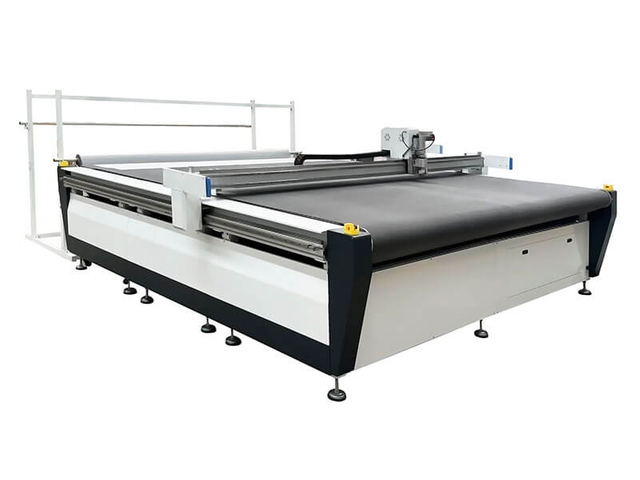
A CNC fabric cutting machine uses an oscillating or rotary knife to cut woven, knitted and technical textiles from a digital marker. It supports single-ply and multi-layer production, reduces manual tracing and cutting errors, and links nesting, projection or conveyor options to the material and order profile.
- Single-ply and multi-layer
- Woven, knit and technical textile
- Conveyor and projection options
The production problem
Fabric cutting is where labour, waste and quality meet.
The cut decides whether a garment or upholstery part reaches sewing at the right size and shape. A small distortion in a knit or slippery synthetic can become a visible seam problem later.
Manual cutting depends on tracing, weights and operator skill. Multi-layer bundles increase the risk: one layer shifts, the part is cut out of alignment and the whole bundle suffers.
A digital cutting table holds the material flat, follows the marker and records the parameters. The same marker can be repeated, nested and revised without remaking a physical template.
How the machine solves it
From drawing to finished part, without a die
Three decisions determine whether the process is reliable: tooling, hold-down and the workflow around the table.
Knife selected for the textile
Oscillating knives suit many woven and technical fabrics; rotary knives can be better for certain dense or coated materials. Tool selection follows the actual material and layer count.
Vacuum and multi-layer control
Vacuum holds the lay-down or single ply during the cut. The table, pump and zoning are sized for the material and expected stack height.
Marker and nesting workflow
DXF, PLT and standard design files can be nested and cut. The operator sees the marker, controls the job and repeats it when the order changes.
Material fit
Materials and tooling
Tell us the exact grade, thickness and sheet or roll size. The same material name can behave differently across suppliers.
| Material | Typical parts | Recommended tooling |
|---|---|---|
| Apparel fabric | Woven, knit and denim | Oscillating or rotary knife |
| Upholstery | Sofa, chair and panel fabric | Oscillating knife |
| Curtain and roller blind | Wide-format textile | Oscillating knife + conveyor |
| Technical textile | Coated and industrial fabric | Material-specific knife |
| Carpet and mat | Floor and automotive textile | Oscillating or rotary tool |
Typical guidance only. A sample cut is required to confirm edge quality, hold-down and the practical tolerance for your material.
Platforms and models
Choose the working area around the part, not the catalogue
Table size, feeding method and tool count matter more than a model number. We can customize the working area around your sheet or roll.
SL1625 fabric platform
- Working area
- 1600 × 2500 mm
- Best fit
- Upholstery, curtains and technical textile
SL2530 fabric platform
- Working area
- 2500 × 3000 mm
- Best fit
- Large-format and conveyor production
Multi-layer configuration
- Working area
- Layer count by material
- Best fit
- Apparel and cut-and-sew production
Projection option
- Working area
- Pattern projection
- Best fit
- Manual pick-and-place after cutting
Factory
Yucheng, Shandong
Assembly, testing and packing under one roof.
Quality system
ISO 9001:2015
Certificate 33926Q00457R053, valid to 30 June 2029.
Europe
ECM document review
0P260623.JSTTT50 reviews submitted documents only; it is not product verification or an EC Declaration of Conformity.
Commercial risk
Test before deposit
Send material; receive cut parts, parameters and a priced configuration.
What the test includes
Send three pieces. Get the cut on video.
Send three A4-sized pieces of the actual material and one drawing in DXF, AI or PDF. We cut at production speed and record the tool, frequency, feed, vacuum zoning and number of passes.
You receive the cut parts by courier, a parameter sheet, a tool recommendation and one priced configuration. No deposit is required to see the test.
Decision support
Questions buyers ask
Direct answers to the questions that usually arrive before a machine specification is approved.
Can the machine cut multiple layers?
Yes, but the practical layer count depends on fabric, thickness, coating, vacuum and knife type. The machine should be specified around the actual lay rather than a generic maximum.
Can it cut slippery or stretch fabrics?
A suitable vacuum table, hold-down method and knife configuration can improve control. Synthetic and stretch materials should be sample-tested.
Is projection available?
Projection can support picking and placing cut parts or guiding downstream operations. Availability depends on the selected platform.
Can it cut curtain and roller-blind fabric?
Yes. Wide-format fabric and conveyor configurations are available for long or roll-fed material.
Next step
Send the fabric, layer count and marker. We will recommend the table and knife.
Include the material, thickness, drawing and output. An engineer will reply within 48 hours, Monday to Saturday, GMT+8.