
Case study
Argentina Racing Gasket Manufacturer Adds Digital Cutting
A hydraulic die line was efficient at volume but slow for samples, one-offs and design revisions. A digital gasket cutter closed the gap.
The situation
The customer manufactures engine gaskets, with a focus on racing applications. Hydraulic die cutting remains an efficient process for the high-volume part of the business. The problem was the work before volume: samples, qualification parts and orders so small that creating a die could cost more than the order.
A racing customer may need a gasket to test an engine combination before committing to production. A single-piece order can still be commercially important. If every new shape waits for a die, the supplier loses the ability to respond quickly.
The process gap
The manufacturer did not need to replace the die press. The factory needed a second route for jobs that did not deserve a die.
The case review compared the two workflows for a small order:
- Digital knife cutting could go from CAD import to finished part in roughly 35 minutes of production work, without die fabrication.
- Hydraulic die cutting could take 10–20 days when die design and manufacture were included, plus several hundred to several thousand dollars of tooling cost.
The exact numbers depend on the part and the factory’s cost structure, but the direction is clear: a die is the wrong tool when the order is a sample or a one-off.
The digital configuration
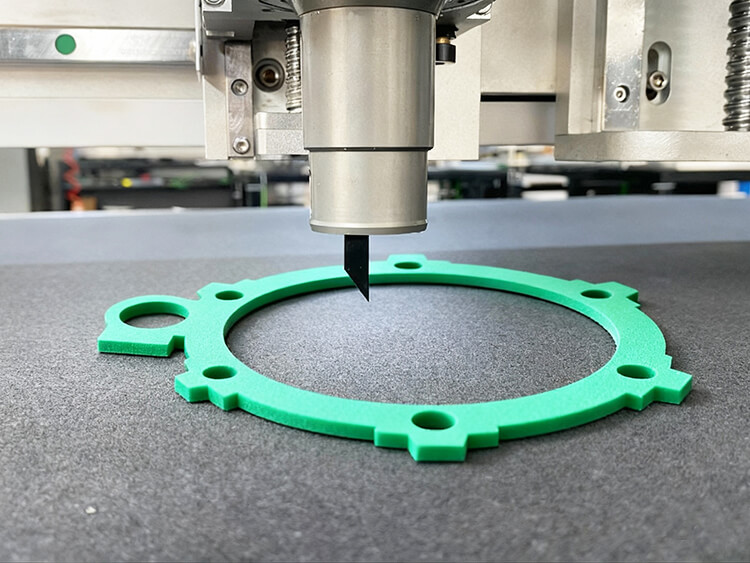
A CNC oscillating knife cutter reads the gasket drawing directly. The operator imports the CAD file, nests the parts and cuts the sheet. A new design is a new file; there is no die to order or store.
The customer also valued gasket nesting software that fits smaller parts into the waste areas around larger irregular profiles. For a gasket manufacturer buying sheet material continuously, better nesting affects the material cost on every order.
Why it works alongside die cutting
The die press still runs the stable, high-volume shapes. The digital cutter handles:
- first articles and samples
- qualification runs
- one-piece replacement gaskets
- designs that may change before production
- orders below the die break-even quantity
That hybrid model is often more practical than replacing an existing press. The digital machine protects the front end of the sales cycle; the press protects the economics of repeat volume.
What to verify in a similar project
Ask for a test on the actual gasket material, not a generic paper sample. The test should confirm:
- clean edges on the fibre or graphite sheet
- bolt-hole position and profile
- vacuum hold-down for small parts
- nesting yield on a realistic sheet
- cutting time for the real part count
Then compare the digital route with the existing die process using the actual annual quantity, die cost and design-change frequency.
The takeaway
Digital cutting is not a universal replacement for die cutting. It is a way to stop the die from becoming the bottleneck for every sample, revision and small order.
For a gasket-specific specification, see CNC gasket cutting machines. To test the material, use the cutting-test process.
Next step
Discuss a similar production problem.
Send the material, part drawing and current process. The first useful answer is whether a knife cutting process fits the job.