
Digital packaging · cut, crease and V-groove
Digital Cardboard Cutting and Creasing Machines
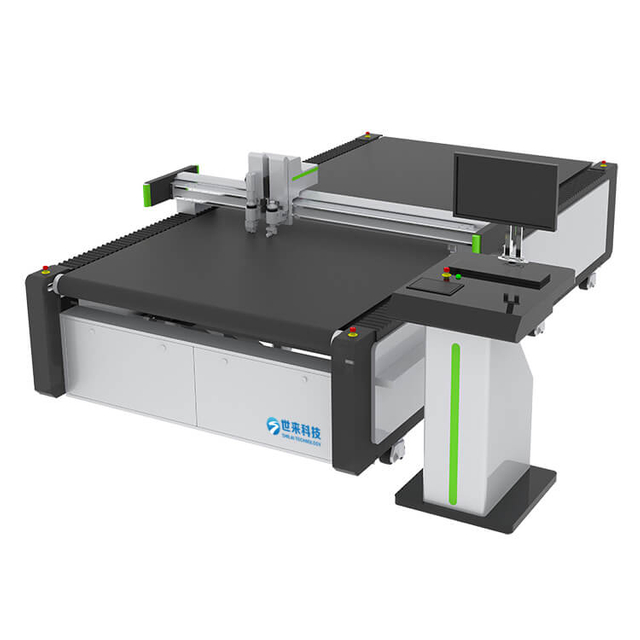
A digital cardboard cutting machine uses an oscillating knife, creasing wheel and V-grooving tool to make boxes, displays and protective packaging directly from a CAD file. It replaces steel dies for prototypes, sample rooms and short runs, so a new box design can be cut and folded the same day.
- Cut, crease and V-groove
- No die for prototypes
- Printed-board CCD option
The production problem
A sample room should not wait for a die.
A packaging designer changes a tuck flap, a display shelf or a fitment by two millimetres. The die shop needs a new tool, the press needs a slot and the customer needs a sample for a review tomorrow.
For short runs and custom packaging, die cost and tooling lead time dominate the economics. The box may be simple, but the order is not large enough to absorb a dedicated die.
A digital cutter turns the sample room into a same-day production cell. Cut, crease and V-groove the first box from the drawing, fold it, check the fit and revise the file before any steel is ordered.
How the machine solves it
From drawing to finished part, without a die
Three decisions determine whether the process is reliable: tooling, hold-down and the workflow around the table.
Creasing and V-grooving in one file
The creasing wheel creates a controlled fold line; the V-groove tool removes material for a clean 90-degree fold on thicker board. No separate die or sample-making machine is needed.
Printed-board registration
A CCD camera aligns the cutting path to printed artwork. That makes short-run displays, gift boxes and labels practical without a mechanical registration jig.
Prototype-to-production consistency
The same digital file can be used for samples and production. The transition to a die, if volume justifies it, starts from a verified design rather than a physical guess.
Material fit
Materials and tooling
Tell us the exact grade, thickness and sheet or roll size. The same material name can behave differently across suppliers.
| Material | Typical parts | Recommended tooling |
|---|---|---|
| Corrugated board | Cartons, inserts and displays | Oscillating knife + crease |
| Honeycomb board | Protective packaging | Oscillating knife + V-groove |
| Grey board and gift box board | Rigid boxes and luxury packaging | Oscillating knife + crease |
| KT board and foam board | Displays and signage | Oscillating knife + router |
| PP hollow sheet | Reusable packaging and signs | Oscillating knife + crease |
Typical guidance only. A sample cut is required to confirm edge quality, hold-down and the practical tolerance for your material.
Platforms and models
Choose the working area around the part, not the catalogue
Table size, feeding method and tool count matter more than a model number. We can customize the working area around your sheet or roll.
SL1610PC
- Working area
- 1600 × 1000 mm
- Best fit
- Gift boxes, printed packaging and prototypes
SL1625CF
- Working area
- 1600 × 2500 mm
- Best fit
- Full-sheet packaging and display production
SL1625HF
- Working area
- 1600 × 2500 mm
- Best fit
- PP hollow sheet and packaging
SL1390CF
- Working area
- 1300 × 900 mm
- Best fit
- Printed cardboard with CCD registration
Factory
Yucheng, Shandong
Assembly, testing and packing under one roof.
Quality system
ISO 9001:2015
Certificate 33926Q00457R053, valid to 30 June 2029.
Europe
ECM document review
0P260623.JSTTT50 reviews submitted documents only; it is not product verification or an EC Declaration of Conformity.
Commercial risk
Test before deposit
Send material; receive cut parts, parameters and a priced configuration.
What the test includes
Send three pieces. Get the cut on video.
Send three A4-sized pieces of the actual material and one drawing in DXF, AI or PDF. We cut at production speed and record the tool, frequency, feed, vacuum zoning and number of passes.
You receive the cut parts by courier, a parameter sheet, a tool recommendation and one priced configuration. No deposit is required to see the test.
Decision support
Questions buyers ask
Direct answers to the questions that usually arrive before a machine specification is approved.
Can the machine cut and crease in one pass?
Yes. A typical packaging configuration carries an oscillating knife, creasing wheel and V-grooving tool in one tool changer or head arrangement. The exact sequence is set in the cutting file.
Will it replace my die cutter?
It replaces die cutting for prototypes, sample rooms, short runs and design changes. High-volume repeat production may still be more economical on a die press after the design is fixed.
Can it cut printed cardboard accurately?
A CCD camera configuration aligns the cut to printed registration marks. Send a printed sheet with your die-line so the camera workflow can be tested.
What file formats does the software accept?
Shilai machine software commonly works with DXF and PLT files, with design files prepared in AutoCAD, Illustrator, CorelDRAW, Inkscape or similar CAD programs. The exact workflow is confirmed with your drawing.
Next step
Send the die-line and board sample. Get a cut, creased and folded prototype.
Include the material, thickness, drawing and output. An engineer will reply within 48 hours, Monday to Saturday, GMT+8.