
CNC foam cutting · inserts and protective packaging
CNC Foam Cutting Machines for EVA, EPE and Packaging Inserts
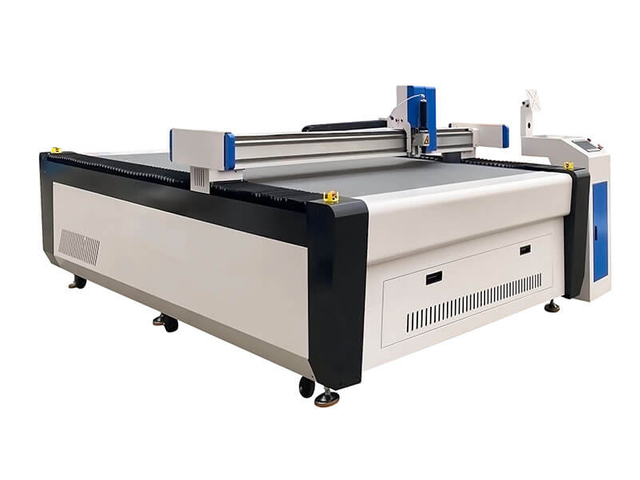
A CNC foam cutting machine uses an oscillating knife to cut soft foam and a milling tool to carve internal pockets. It replaces hot-wire and die-based processes for EVA, EPE, PU, EPS and protective packaging inserts, producing a clean vertical wall without compressing the foam or spending weeks on tooling.
- Knife + router in one setup
- Up to 100 mm depending on density
- No compression marks
The production problem
Foam shows every bad cut.
A packaging insert has two jobs: hold the product precisely and look like it belongs in the box. A compressed edge, torn pocket wall or inconsistent cavity depth is visible before the customer opens the product.
Hot wire and laser processes can leave a hardened or discoloured face. Steel dies are expensive for the short runs and design iterations common in custom packaging. Manual cutting struggles with repeatable cavities and tight radii.
A knife table cuts the outline cold and a router mills the pocket. The foam is held by vacuum, the tool path comes from CAD and the same file can be revised without ordering another die.
How the machine solves it
From drawing to finished part, without a die
Three decisions determine whether the process is reliable: tooling, hold-down and the workflow around the table.
One machine, outline and pocket
An oscillating knife cuts the external profile; a high-speed milling tool carves the internal cavity. The part stays in one setup, which keeps the pocket aligned to the outline.
Vacuum hold-down without crushing
Zoned vacuum keeps the sheet flat while allowing the knife to move. The cut face stays open and the cell structure is not compressed by a clamp.
Material-specific tooling
Dense EVA usually needs a 400 W oscillating knife; softer EPE and sponge may need a pneumatic knife. The correct blade and feed change the edge quality.
Material fit
Materials and tooling
Tell us the exact grade, thickness and sheet or roll size. The same material name can behave differently across suppliers.
| Material | Typical parts | Recommended tooling |
|---|---|---|
| EVA foam | Tool cases and packaging inserts | Oscillating knife + router |
| EPE and PE foam | Protective packaging | Pneumatic or oscillating knife |
| PU and sponge | Cushioning and cases | Pneumatic knife |
| EPS and XPS | Rigid foam and insulation | Oscillating knife or router |
| EPDM and PVC foam | Seals and gaskets | Oscillating knife or conveyor |
Typical guidance only. A sample cut is required to confirm edge quality, hold-down and the practical tolerance for your material.
Platforms and models
Choose the working area around the part, not the catalogue
Table size, feeding method and tool count matter more than a model number. We can customize the working area around your sheet or roll.
SL1625FM
- Working area
- 1600 × 2500 mm, knife + mill
- Best fit
- Custom EVA inserts and cavities
SL1325FF
- Working area
- 1300 × 2500 mm
- Best fit
- EVA and EPE sheet cutting
SL1625FF
- Working area
- 1600 × 2500 mm
- Best fit
- Large foam sheets and packaging
SL1625FC
- Working area
- 1600 × 2500 mm + conveyor
- Best fit
- EPDM and foam roll stock
Factory
Yucheng, Shandong
Assembly, testing and packing under one roof.
Quality system
ISO 9001:2015
Certificate 33926Q00457R053, valid to 30 June 2029.
Europe
ECM document review
0P260623.JSTTT50 reviews submitted documents only; it is not product verification or an EC Declaration of Conformity.
Commercial risk
Test before deposit
Send material; receive cut parts, parameters and a priced configuration.
What the test includes
Send three pieces. Get the cut on video.
Send three A4-sized pieces of the actual material and one drawing in DXF, AI or PDF. We cut at production speed and record the tool, frequency, feed, vacuum zoning and number of passes.
You receive the cut parts by courier, a parameter sheet, a tool recommendation and one priced configuration. No deposit is required to see the test.
Decision support
Questions buyers ask
Direct answers to the questions that usually arrive before a machine specification is approved.
Can one machine cut the outline and mill the pocket?
Yes. The SL1625FM combines an oscillating knife for the outside profile with a high-speed milling tool for internal cavities.
How thick can it cut?
The machine family publishes a maximum capability up to 100 mm. Practical thickness falls as foam density and hardness rise. A 55° EVA sample may be practical around 60 mm, while softer lower-density foam can run closer to the maximum.
Will vacuum hold-down crush the foam?
The vacuum is selected and zoned to hold the sheet without collapsing the cell structure. The right vacuum level and support surface depend on the material.
Can it cut EPE as well as EVA?
Yes. EPE and other softer foams often use a pneumatic knife and a different feed strategy. Send the density and a sample so the tooling is not guessed.
Next step
Send the foam density, thickness and a drawing. We will cut the part and film it.
Include the material, thickness, drawing and output. An engineer will reply within 48 hours, Monday to Saturday, GMT+8.