
CNC composite cutting · dry fabric and prepreg
CNC Composite Cutting Machines for Carbon and Glass Fibre
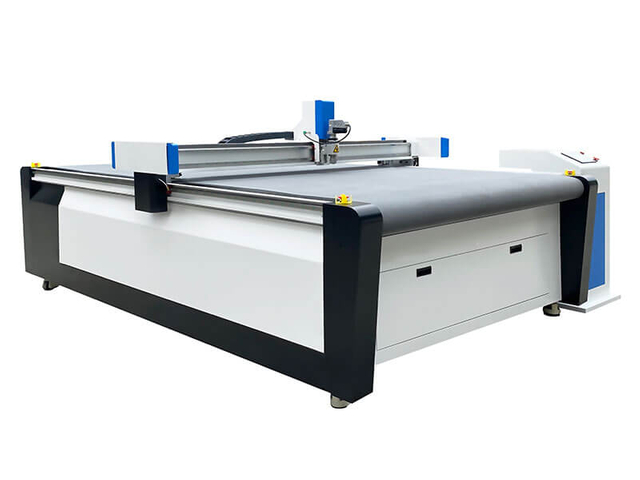
A CNC composite cutting machine cuts dry carbon fibre, fibreglass, aramid and prepreg with an oscillating or rotary knife. It produces a clean ply edge without fraying or heat damage, and a conveyor or liner system keeps tacky prepreg moving through the table for repeatable ply kits.
- No frayed carbon or glass edges
- Dry fabric and tacky prepreg
- Conveyor and liner options
The production problem
A clean ply edge is a structural requirement, not a finish.
Frayed carbon, pulled aramid and distorted fibreglass create problems that show up later in layup, resin flow and finished-part tolerance. The cut is the first step in the laminate, not a cosmetic operation.
Laser cutting can damage the binder or leave a heat-affected edge. Hand cutting depends on templates, scissors and operator patience, which is difficult to repeat across complex ply books.
A digital cutting table turns each ply into a repeatable file. The knife follows the fibre direction, the vacuum holds the fabric without stretching it and the next kit can be nested without a physical template.
How the machine solves it
From drawing to finished part, without a die
Three decisions determine whether the process is reliable: tooling, hold-down and the workflow around the table.
Tooling matched to the fabric
Dry carbon and fibreglass may use an oscillating or rotary knife; aramid and Kevlar need sharp, low-drag tooling to avoid fuzzing. The selected tool and feed depend on weave and areal weight.
Handling for tacky prepreg
Prepreg needs a liner, release film and a controlled feed path. Conveyor and liner-handling options keep the material moving instead of stretching it across a static table.
Nesting for ply books
Multiple plies and mirror pairs can be nested from the same CAD set. Each kit is cut in the intended sequence, reducing manual sorting and missing pieces.
Material fit
Materials and tooling
Tell us the exact grade, thickness and sheet or roll size. The same material name can behave differently across suppliers.
| Material | Typical parts | Recommended tooling |
|---|---|---|
| Carbon fibre fabric | Dry reinforcement and prepreg | Oscillating or rotary knife |
| Fibreglass | Dry cloth, mat and prepreg | Oscillating or rotary knife |
| Aramid and Kevlar | High-strength fabric | Sharp drag or oscillating knife |
| Prepreg | Tacky resin-impregnated ply | Oscillating knife + liner handling |
| Honeycomb and foam core | Structural cores | Oscillating knife or router |
Typical guidance only. A sample cut is required to confirm edge quality, hold-down and the practical tolerance for your material.
Platforms and models
Choose the working area around the part, not the catalogue
Table size, feeding method and tool count matter more than a model number. We can customize the working area around your sheet or roll.
SL1625CF
- Working area
- 1600 × 2500 mm + conveyor
- Best fit
- Dry carbon, fibreglass and roll goods
SL1625PF
- Working area
- 1600 × 2500 mm
- Best fit
- Prepreg and liner handling
SL1331PF
- Working area
- 1300 × 3100 mm
- Best fit
- Phenolic duct and composite panels
Custom width
- Working area
- Up to 1600 mm+
- Best fit
- Roll width, ply size and layup plan
Factory
Yucheng, Shandong
Assembly, testing and packing under one roof.
Quality system
ISO 9001:2015
Certificate 33926Q00457R053, valid to 30 June 2029.
Europe
ECM document review
0P260623.JSTTT50 reviews submitted documents only; it is not product verification or an EC Declaration of Conformity.
Commercial risk
Test before deposit
Send material; receive cut parts, parameters and a priced configuration.
What the test includes
Send three pieces. Get the cut on video.
Send three A4-sized pieces of the actual material and one drawing in DXF, AI or PDF. We cut at production speed and record the tool, frequency, feed, vacuum zoning and number of passes.
You receive the cut parts by courier, a parameter sheet, a tool recommendation and one priced configuration. No deposit is required to see the test.
Decision support
Questions buyers ask
Direct answers to the questions that usually arrive before a machine specification is approved.
Can the same machine cut dry fabric and prepreg?
Yes, with the right tool and material-handling setup. Prepreg usually needs liner handling and a different feed strategy from dry fabric, so it should be specified at quotation rather than added as an afterthought.
Will the edge fray?
A properly selected knife and feed produce a clean ply edge. Aramid and Kevlar are more demanding than carbon or glass, so a sample cut is the reliable way to confirm edge quality.
Can you handle 1300 mm rolls?
Yes. The Serbian UAV case used 1300 mm wide roll material with automatic feeding. Working width and roll handling are configured around the actual material.
Is a laser better for composites?
For many dry fabrics and prepreg, no. Heat can affect the binder or resin and create an edge that behaves differently in layup. A knife is a cold cut.
Next step
Send one ply of your actual composite. We will cut it and show the edge.
Include the material, thickness, drawing and output. An engineer will reply within 48 hours, Monday to Saturday, GMT+8.