
Case study
Mexico Packaging Maker Moves Into Custom EVA Inserts
A packaging manufacturer moved from commodity cushioning into higher-margin custom EVA inserts with one knife-and-router machine.
The opportunity
The customer produced foam and bubble-wrap cushioning. Commodity protective packaging is a volume business; custom EVA inserts for tools, electronics and cases can carry a higher margin and a closer relationship with the product designer.
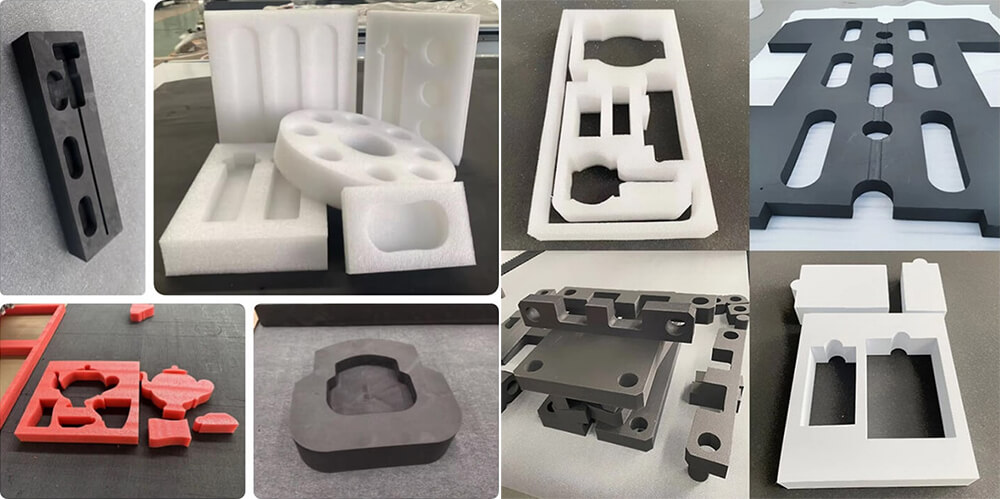
The move required a new production capability. A custom insert usually has two features: an external profile that fits the box and an internal cavity that holds the product. The cavity depth and outline must match the product, and the foam face should look clean when the box is opened.
The material specification
The project was not quoted around a generic “EVA foam” label. The customer supplied:
- EVA density: 64 kg/m³
- hardness: 55°
- sheet size: 1.39 × 2.90 m
- maximum thickness: 50 mm
Those details changed the machine recommendation. The table needed to fit the sheet with handling margin, and the cutting head needed enough Z travel above a 50 mm part.
The machine configuration
A 1.5 × 3 m platform was chosen so the 1.39 × 2.90 m sheet could be loaded without unnecessary table width. The Z-axis travel was set to 60 mm, giving working room above the maximum material thickness.
The machine combined a 400 W oscillating knife for the outside profile with a high-speed milling tool for internal cavities. The knife cut the insert shape; the router created the pocket. The part stayed on the same vacuum table between operations.
Why the tool matters
Not every foam tool produces the same face. A knife selected for dense EVA can leave an open, vertical wall. A pneumatic knife may be better for softer EPE or sponge. The customer’s 55° EVA was a different application from low-density packaging foam.
The practical maximum thickness also depends on density. A machine may publish 100 mm capability, but dense EVA will not necessarily cut at that thickness at production quality. The material and tool should decide the usable range.
What the buyer gained
The machine let the packaging company quote custom inserts without buying a steel die for each design. New products and revised cavities became CAD changes rather than tooling projects.
That does not mean every order is profitable. The company still has to design the insert, select foam, prove the fit and control the cutting time. The machine removes the tooling barrier; it does not replace the packaging engineering.
What to test
For a similar EVA project, test:
- the actual foam grade and density
- the maximum and minimum thickness
- the outside profile and pocket geometry
- the required edge and surface finish
- hold-down for small or narrow parts
- chip extraction from the milling operation
- cycle time for the real insert
A complete test should return a cut and milled insert, not only a square foam sample.
The takeaway
Custom packaging becomes easier to sell when the tooling cost disappears from the first order. A knife-and-mill machine is a practical entry point for a packaging manufacturer moving into higher-value foam inserts.
See CNC foam cutting machines and the SL1625FM configuration, or send a product outline for a test insert.
Next step
Discuss a similar production problem.
Send the material, part drawing and current process. The first useful answer is whether a knife cutting process fits the job.