
Automotive interiors · seats, trim, carpets and foam
CNC Cutting Machines for Automotive Interiors
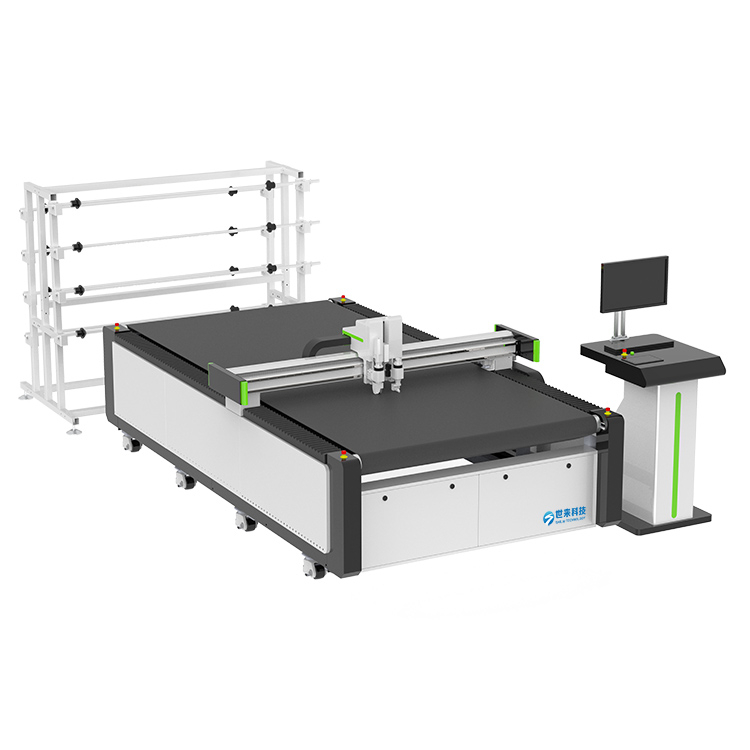
Automotive interior cutting requires one workflow for leather, fabric, foam, carpet and nonwoven trim. A CNC knife cutting machine with nesting and conveyor feed cuts seat covers, door panels, floor mats and trim parts from CAD, reducing manual templates and improving repeatability across material changes.
- Seat covers and trim
- Leather, fabric, foam and carpet
- Conveyor and nesting options
The production problem
Interior parts share a production line, but not the same material behaviour.
A seat cover may be leather, perforated synthetic or a laminated fabric. A door panel may include foam and nonwoven. Each material behaves differently under a blade, and the trimming allowance changes with the lamination.
Automotive programmes also demand repeatability. A template that works for one material may not suit a new grade, and hand trimming makes it difficult to compare one production lot with the next.
A digital cutting table lets the same CAD part be cut across material grades with a recorded tool and feed. The operator changes the material and the machine recipe, not the physical template.
How the machine solves it
From drawing to finished part, without a die
Three decisions determine whether the process is reliable: tooling, hold-down and the workflow around the table.
Material recipes for each trim
Leather, fabric, foam and carpet are stored with their own tool, feed and vacuum settings. A material change becomes a controlled setup rather than a new manual technique.
Nesting for expensive leather and fabric
The nesting software places parts around usable areas and defect zones. For leather and coated fabric, the yield improvement can outweigh a small speed difference.
Conveyor for cut-and-sew flow
Continuous feeding supports roll materials and longer programmes. Cut parts move off the cutting zone while the next section is prepared.
Material fit
Materials and tooling
Tell us the exact grade, thickness and sheet or roll size. The same material name can behave differently across suppliers.
| Material | Typical parts | Recommended tooling |
|---|---|---|
| Automotive leather | Seats, trim and steering wheels | Oscillating or rotary knife |
| Seat fabric | Covers and inserts | Oscillating knife |
| Foam laminate | Seat and trim padding | Oscillating knife |
| Carpet and nonwoven | Floor and trunk trim | Oscillating or rotary knife |
| Coated textile | Door panels and console trim | Material-specific knife |
Typical guidance only. A sample cut is required to confirm edge quality, hold-down and the practical tolerance for your material.
Platforms and models
Choose the working area around the part, not the catalogue
Table size, feeding method and tool count matter more than a model number. We can customize the working area around your sheet or roll.
SL1625CL
- Working area
- 1600 × 2500 mm + conveyor
- Best fit
- Seat covers, trim and roll material
SL2530CL
- Working area
- 2500 × 3000 mm
- Best fit
- Large hides and nesting
SL1625 fabric platform
- Working area
- 1600 × 2500 mm
- Best fit
- Seat fabric and technical textile
Custom
- Working area
- By material and part
- Best fit
- Automotive programme configuration
Factory
Yucheng, Shandong
Assembly, testing and packing under one roof.
Quality system
ISO 9001:2015
Certificate 33926Q00457R053, valid to 30 June 2029.
Europe
ECM document review
0P260623.JSTTT50 reviews submitted documents only; it is not product verification or an EC Declaration of Conformity.
Commercial risk
Test before deposit
Send material; receive cut parts, parameters and a priced configuration.
What the test includes
Send three pieces. Get the cut on video.
Send three A4-sized pieces of the actual material and one drawing in DXF, AI or PDF. We cut at production speed and record the tool, frequency, feed, vacuum zoning and number of passes.
You receive the cut parts by courier, a parameter sheet, a tool recommendation and one priced configuration. No deposit is required to see the test.
Decision support
Questions buyers ask
Direct answers to the questions that usually arrive before a machine specification is approved.
Can the machine cut leather, fabric and foam on the same platform?
Yes, with different tool and feed configurations. The material recipes and hold-down method should be documented during the sample test.
Do you support roll materials?
Conveyor configurations are available for roll goods. Working width and feed length are selected around the actual material.
Can you nest around hide defects?
The leather vision system can identify hide contours and defect areas for nesting. The exact workflow depends on the material and the required marker.
What about PPAP or production approval?
The machine can produce repeatable parts and documented parameters, but the customer remains responsible for their own automotive quality and approval process. We can provide machine test records and configuration data.
Next step
Send the material stack and a representative part. We will build the cutting recipe around it.
Include the material, thickness, drawing and output. An engineer will reply within 48 hours, Monday to Saturday, GMT+8.