
Print finishing · CCD registration · kiss-cut
Digital Flatbed Cutters for Signage, Print and Display Materials
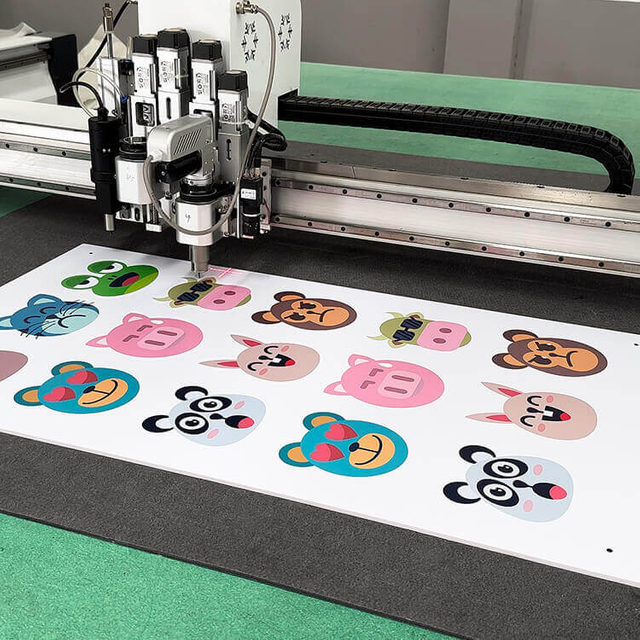
An advertising cutting machine is a digital flatbed cutter that combines a tangential knife, kiss-cut drag knife, CCD camera and optional router. It finishes printed and unprinted signage materials such as KT board, vinyl, PP hollow, magnetic sheet and foam board without hand trimming or a steel die.
- CCD print-and-cut registration
- Kiss-cut and through-cut
- Routing option for rigid board
The production problem
Print quality means nothing if the finishing is off.
A printed display can leave the printer perfectly and still fail at the cutter. Registration drifts, vinyl is cut through the liner, or a rigid board is trimmed by hand with a visible wavy edge.
Short-run signage, exhibition graphics, labels and packaging prototypes rarely justify a die. The shop needs a digital finishing cell that can switch from stickers to KT board to a small production run without rebuilding the process.
A flatbed cutter with a CCD camera reads registration marks, aligns the contour and switches tools. One operator can finish a printed sheet, weed it and move to the next file.
How the machine solves it
From drawing to finished part, without a die
Three decisions determine whether the process is reliable: tooling, hold-down and the workflow around the table.
CCD registration for printed work
The camera detects printed marks and aligns the cut path to the artwork. Kiss-cut through the vinyl while leaving the liner intact, or cut through the complete sheet.
Tools for rigid and flexible media
Tangential knife, drag knife, creasing wheel, V-groove and router options cover vinyl, KT board, foam board, PP hollow sheet, magnetic sheet and labels.
One operator, short-run flexibility
The job file controls the tool path. Design changes do not require a new die, so short runs and prototypes can share the same machine.
Material fit
Materials and tooling
Tell us the exact grade, thickness and sheet or roll size. The same material name can behave differently across suppliers.
| Material | Typical parts | Recommended tooling |
|---|---|---|
| Vinyl and sticker film | Labels, decals and print-and-cut | Kiss-cut drag knife + CCD |
| KT board and foam board | Displays and models | Oscillating knife or router |
| PP hollow sheet | Reusable signs and packaging | Oscillating knife + crease |
| Magnetic sheet | Vehicle and promotional signs | Oscillating or drag knife |
| Honeycomb board | Display and protective packaging | Oscillating knife |
Typical guidance only. A sample cut is required to confirm edge quality, hold-down and the practical tolerance for your material.
Platforms and models
Choose the working area around the part, not the catalogue
Table size, feeding method and tool count matter more than a model number. We can customize the working area around your sheet or roll.
SL1325PF
- Working area
- 1300 × 2500 mm + CCD
- Best fit
- KT board, Sunboard and printed signage
SL1610PC
- Working area
- 1600 × 1000 mm + CCD
- Best fit
- Printed packaging and gift boxes
SL1625PC
- Working area
- 1600 × 2500 mm + CCD
- Best fit
- Large-format display production
SL1390AF
- Working area
- 1300 × 900 mm
- Best fit
- Printed labels and kiss-cut sheets
Factory
Yucheng, Shandong
Assembly, testing and packing under one roof.
Quality system
ISO 9001:2015
Certificate 33926Q00457R053, valid to 30 June 2029.
Europe
ECM document review
0P260623.JSTTT50 reviews submitted documents only; it is not product verification or an EC Declaration of Conformity.
Commercial risk
Test before deposit
Send material; receive cut parts, parameters and a priced configuration.
What the test includes
Send three pieces. Get the cut on video.
Send three A4-sized pieces of the actual material and one drawing in DXF, AI or PDF. We cut at production speed and record the tool, frequency, feed, vacuum zoning and number of passes.
You receive the cut parts by courier, a parameter sheet, a tool recommendation and one priced configuration. No deposit is required to see the test.
Decision support
Questions buyers ask
Direct answers to the questions that usually arrive before a machine specification is approved.
What is the difference between kiss-cutting and through-cutting?
Kiss-cutting cuts the printed film but leaves the backing liner intact, which is useful for labels and stickers. Through-cutting goes through the complete material and is used for loose parts or sheets.
Can the machine cut printed material accurately?
A CCD camera configuration reads registration marks and aligns the tool path to the print. The quality of the printed marks and material also affect the result.
Can it cut rigid acrylic?
A router option can cut or mill some rigid materials. The exact capability depends on the material, thickness and tool; it should be confirmed with a sample.
Do I need a separate plotter for vinyl?
A flatbed cutter can handle kiss-cut vinyl and many printed sign materials, but the best setup depends on the size mix and daily volume. We compare both workflows during configuration.
Next step
Send a printed sheet. We will kiss-cut or through-cut it and show the registration.
Include the material, thickness, drawing and output. An engineer will reply within 48 hours, Monday to Saturday, GMT+8.